
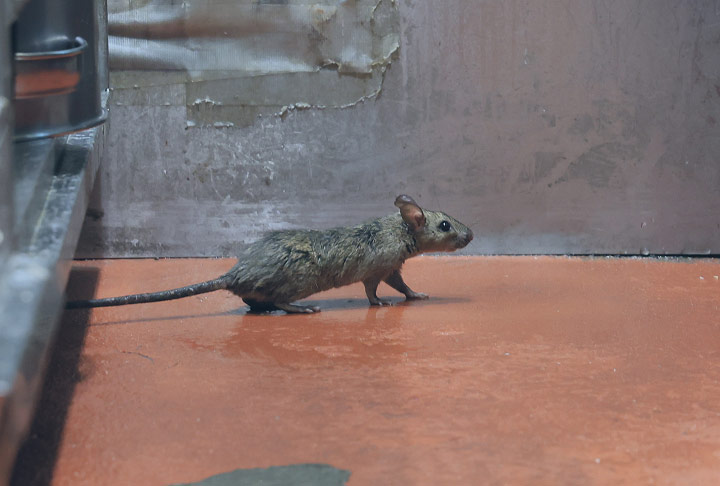
Proposals for Rat Intrusion Prevention
Introduction: Why We Need to Rethink Our Approach to Rat Intrusion Prevention
Rats are not merely an unpleasant nuisance -- they are a sanitary pest that brings with it a wide range of serious risks, including the transmission of infectious diseases, threats to food safety, and damage to equipment and facilities.
In recent years, rats have been identified as potential carriers of bacteria such as Salmonella, capable of transmitting food-borne illness -- and their significance as a risk management concern in the livestock and food industries is growing.
Despite this, pest control on the ground often remains limited to reactive responses such as:
- Catching rats when they are spotted
- Exterminating when damage appears
This kind of reactive approach is simply not enough. Rats are highly intelligent learners with a remarkable capacity to adapt to their environment.
Waiting until rats appear before taking action leads to an endless cycle -- a game of cat and mouse that is difficult to win. That is precisely why the rat control of the future must shift away from "extermination" and toward "designing spaces that prevent entry" and "creating environments where rats cannot settle".
Why Conventional Rat Control Is Becoming Less Effective
An increasing number of practitioners are reporting that rat control "doesn't work as well as it used to." Several structural changes underlie this trend.
One is the rise of the black rat and the problem of rodenticide resistance. Black rats are naturally cautious and reluctant to consume bait -- and rodenticide-resistant individuals are increasingly being encountered, meaning conventional rodenticides alone are no longer reliably effective. Rats are also extremely fast learners: once they associate a trap location or area with danger, they simply avoid it. As a result, strategies that rely solely on glue traps or capture devices tend to lose their effectiveness over time. Additionally, in food processing facilities, retail environments, and livestock settings, there is a growing shift toward reduced chemical use -- and situations where rodenticides simply cannot be applied are becoming more common.
When the risks of foreign body contamination and impact on livestock are taken into account, many facilities find themselves unable to use chemical treatments even when they would like to. Taken together, we are entering an era where approaches focused solely on "killing" or "catching" are no longer sufficient.
The Essence of Intrusion Prevention: Thinking Through the Rat Life Cycle
Rat behavior follows a repeating cycle:
Intrusion → Roaming → Nesting → Breeding
Stopping any single stage of this cycle still allows the same pattern to resume from another point.
For example:
- Catch the rats, but leave the entry points open -- and they simply come back in
- Destroy a nest, but leave an environment where roaming is possible -- and they build another one elsewhere
This is precisely why what matters is:
A control strategy designed with all three stages -- intrusion, roaming, and nesting -- in mind from the outset.
Rather than one-off extermination, creating an environment that makes rat life as a whole impossible is the true essence of effective intrusion prevention.
Environmental Improvement: Creating Spaces That Rats Find Uninhabitable
The foundation of effective intrusion prevention is the concept of environmental improvement.
This means:
- Denying rats access to food
- Preventing them from building nests
- Making movement through the space impossible or undesirable
-- in short, transforming the space into somewhere rats find deeply uncomfortable.
When their environment becomes inhospitable, rats will naturally move on to somewhere else. By leveraging this instinct, it becomes possible to prevent them from ever becoming established -- without having to repeatedly force extermination.
Current Control Methods and Their Limitations
The most commonly used rat control methods today include:
- Physical control (traps, etc.)
- Chemical control (rodenticides, etc.)
- Gnawing deterrents and odor-based repellents
However, all of these share a common characteristic: they tend to remain partial solutions. Catching rats means nothing if the entry points remain open. Rodenticides are ineffective against resistant individuals. Odor-based repellents lose their impact once rats become accustomed to them.
The reality is that relying on any single method simply cannot keep pace with rat activity. What is needed going forward is a design-led, multi-layered approach that combines multiple perspectives.
Where "Rat Repellent Device Z" Fits In: A New Approach to Intrusion Prevention
It was against this backdrop that "Rat Repellent Device Z" was developed.
"Rat Repellent Device Z" features a proprietary structure designed based on rat behavioral characteristics, and has been granted a Utility Model Registration (No. 3088389).
Utility model registration requires that the structure be genuinely practical and usable in real-world applications -- a standard that confirms "Rat Repellent Device Z" was engineered from a field-first perspective.
Refined through years of installation experience and ongoing verification, its structure delivers the versatility to be applied effectively across a wide range of facilities and environments.
What Changes with "Rat Repellent Device Z": Stopping Entry, Roaming, and Nesting
The strength of "Rat Repellent Device Z" lies not simply in "blocking entry" -- it goes further by directly influencing rat behavior itself:
- Causing rats to stop in their tracks at points where they would otherwise enter
- Disrupting their ability to roam freely within a building
- Making the environment difficult for nesting
As confirmed in the field study, rats were observed hesitating and turning back when approaching the devices, and fleeing in distress upon contact -- demonstrating a clear and measurable behavioral suppression effect.
This means the device has the capacity to break the cycle of intrusion → roaming → nesting at its core.
"Rat Repellent Device Z" is not merely a supplementary tool -- it can serve as the central component of an intrusion prevention design strategy.
Key Principles in Installation and Design
The key to achieving results is designing for the specific conditions of each facility. Rat entry routes and movement patterns vary significantly depending on a building's structure and how it is used. A one-size-fits-all installation approach is therefore unlikely to deliver sufficient results.
- Where are they entering from?
- What routes are they using?
- Where are they congregating?
Answering these questions and then placing the devices precisely at the points where rats find passage unpleasant or impossible -- this is what matters. It is this design expertise that ultimately determines whether intrusion prevention succeeds or fails.
Running Costs and Ongoing Maintenance
Another key advantage of "Rat Repellent Device Z" is its semi-permanent, durable construction.
- No need for regular repurchasing as with chemical treatments
- Replacement work is almost never required
- Highly resistant to deterioration
As a result, ongoing management is possible while keeping running costs low. Because rat control is never a one-time task, the ability to sustain a measure over the long term is an essential quality -- and a "solution that can be maintained continuously" is a crucial advantage.
Closing Thoughts: Rat Control Is Never a One-Time Fix
Rats have memory. Once they have established themselves somewhere, they will return again and again. They also adapt quickly to environmental changes -- finding new gaps to squeeze through and creating new routes. That is precisely why regular monitoring and ongoing adjustment are indispensable. Intrusion prevention should not be thought of as "install and done" -- it must be built into operations as an ongoing management system.
Summary: The Right Approach to Intrusion Prevention Going Forward
Effective rat intrusion prevention going forward requires a fundamental shift in thinking -- away from extermination-focused responses, and toward environmental improvement and design-led prevention.
Not point-by-point fixes, but a systemic, space-wide approach that makes rat life itself impossible to sustain.
At the heart of that approach is "Rat Repellent Device Z".
"Rat Repellent Device Z":
- Directly influences rat behavior
- Suppresses intrusion, roaming, and nesting
- Is easy to maintain on a continuous basis
These qualities make it a material that can be placed at the center of future intrusion prevention design.
Move rat control from "making do in the moment" to "building a sustainable system." As a first step toward that goal, we invite you to consider an intrusion prevention strategy built around Rat Repellent Device Z.